Turn one Lesson into two kinds of practice
Flashcards are your own call on whether you knew it. Learn questions are checked answers. The same Lesson can feed both without you writing the material twice.
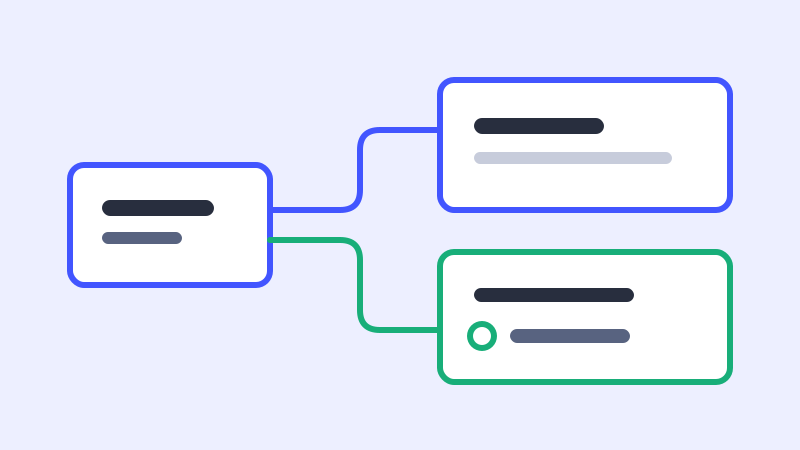
A useful Lesson is not just a container for things you collected. It is a small source of context that can be practiced in more than one way. When you save an English phrase, a grammar note, or a reading excerpt, you should not have to rewrite it just because you want both quick recall and answer-checked practice.
MemorizeKit treats those practice modes as different views of the same study material. You can return to the Blog index after this guide, or use the public Explore Lessons preview to see how study material can be grouped before practice begins.
Start with one Lesson
Start by thinking of a Lesson as the study session you are building around a source. The source might be a short article, a podcast transcript, a list of expressions from class, or a set of sentences you want to imitate. The important part is that the Lesson keeps the examples close enough that each Term still has meaning.
For example, imagine a Lesson called “Job interview answers.” It might include the phrase “walk me through,” a useful structure like “I have been responsible for…”, and a short answer you want to refine. Those pieces belong together because they come from the same real communication task.
Use Flashcards for quick self-rated recall
Flashcards are useful when you can honestly judge whether you remembered enough. A card might ask for the meaning of “walk me through,” or it might show the Vietnamese prompt and ask you to recall the English phrase. You look at your answer, compare it with the saved context, and decide whether your memory was strong enough.
This mode works well for vocabulary, phrase recall, and short structures. It is quick, flexible, and forgiving. You are not trying to prove that one exact answer is the only possible answer. You are checking whether the memory is available when you need it.
Use Learn when the answer can be checked
Learn is better when the practice has a clearer answer. A multiple choice question, a cloze sentence, or a short typed answer can be checked more directly than a broad speaking prompt. The same Lesson can provide the sentence, hint, or explanation that makes the checked answer fair.
For example, the Lesson sentence “Could you walk me through your last project?” can become a Learn question that asks which phrase means “explain step by step.” That is different from a Flashcard, but it still points back to the same source context.
A short routine that combines both
A simple routine is enough. First, scan the Lesson and choose the Terms that matter today. Next, use Flashcards for five minutes to wake up recall. Then switch to Learn for the Terms where a checked answer will expose confusion. End by opening the Lesson again and reading the original examples in order.
That routine keeps practice lightweight. Flashcards tell you whether the memory is available. Learn tells you whether the answer survives a more specific prompt. The Lesson keeps both modes anchored to the reason you saved the material in the first place.
Keep the source context
The biggest mistake is splitting every useful phrase into isolated drills too early. If you remove the context, you may remember a translation but forget when the phrase sounds natural. Keep the Lesson as the home for examples, notes, and short explanations, then let Flashcards and Learn project from that source.
Over time, this makes your library easier to trust. You know where a card came from, why a question exists, and what real sentence made the Term worth saving.